Research
We work at the frontier of nuclear theory and astrophysical observation — using neutron stars as natural laboratories for matter at extreme densities, gravitational waves, and dark matter.
What we actually compute
Six themes. Each is a nuclear-physics question tied to an observable LIGO, NICER, or a radio telescope can measure.
Equation of State of Dense Matter
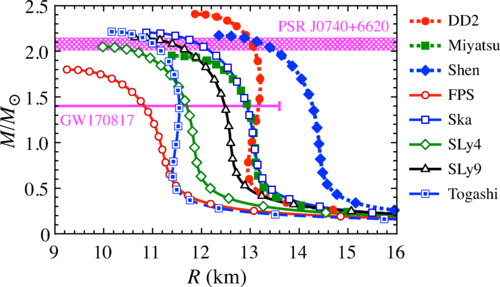
The equation of state (EoS) — how pressure relates to density — governs every observable property of a neutron star. We develop relativistic mean-field (RMF) models calibrated to nuclear laboratory data, then confront them with astrophysical observations: LIGO tidal deformability, NICER X-ray mass-radius measurements, and pulsar maximum masses. Key models include the NITR EoS family, G3, IOPB-I, and BigApple parameter sets.
Gravitational Waves & Stellar Oscillations
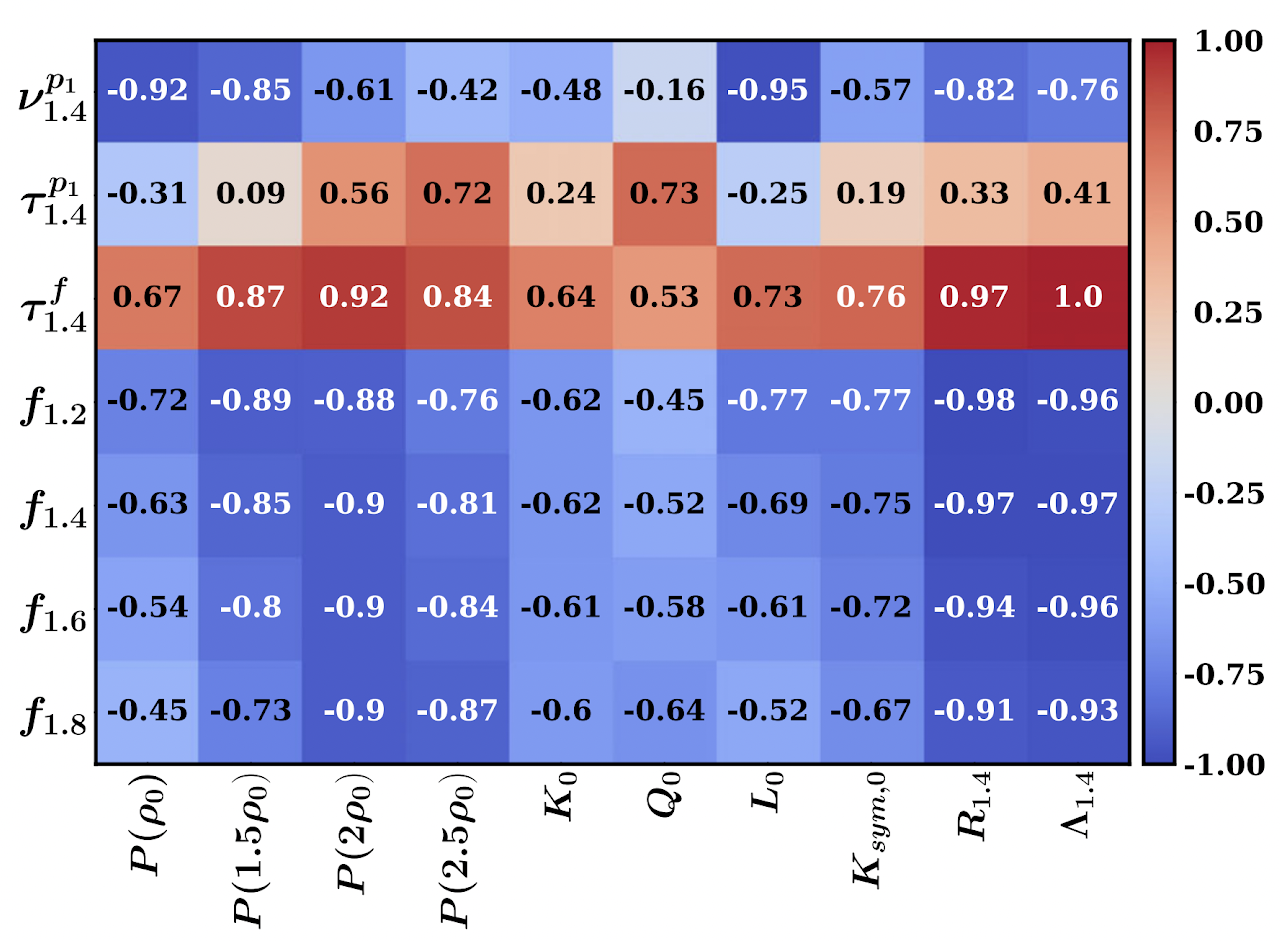
Oscillating neutron stars emit continuous gravitational waves. We compute quasinormal mode frequencies (f-modes, p-modes, w-modes) in full general relativity, and derive universal I-Love-Q and oscillation–tidal-deformability relations insensitive to the EoS. These provide direct tests with next-generation detectors (Einstein Telescope, Cosmic Explorer) and are comparable to post-merger GW signals.
Dark Matter in Neutron Stars
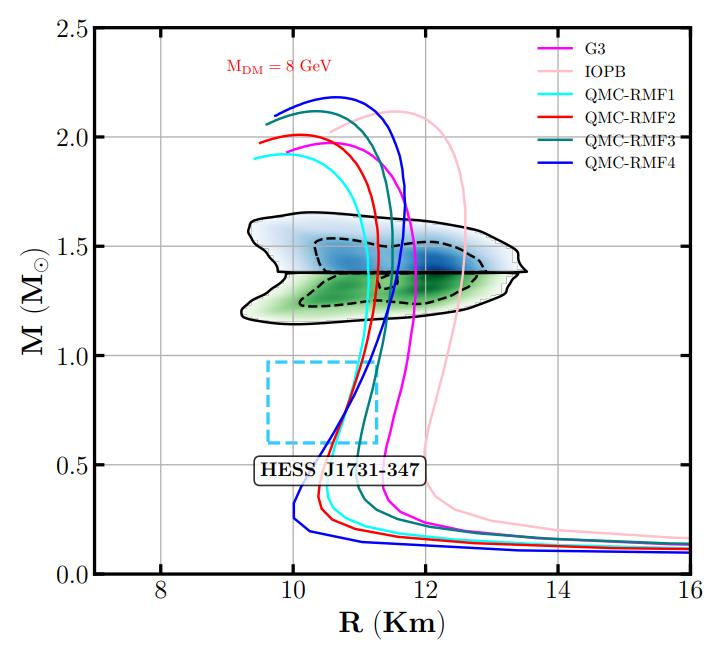
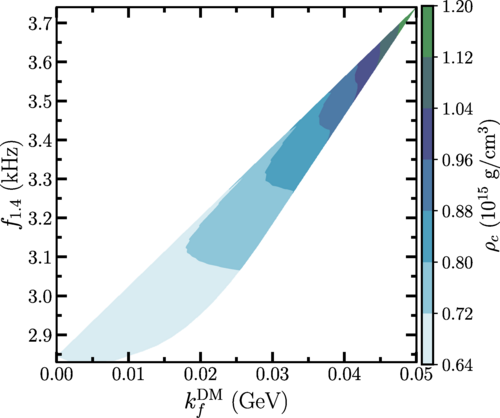
Neutron stars can capture and accumulate dark matter over their lifetime. We model WIMP, fermionic, and self-interacting dark matter effects on neutron star structure through two-fluid TOV equations. Mass, radius, tidal deformability, and oscillation frequencies shift in characteristic ways that constrain the dark matter–nucleon cross-section and particle mass, connecting to PSR J0952-0607 and HESS J1731-347.
Hyperons, Delta-Baryons & Exotic Matter
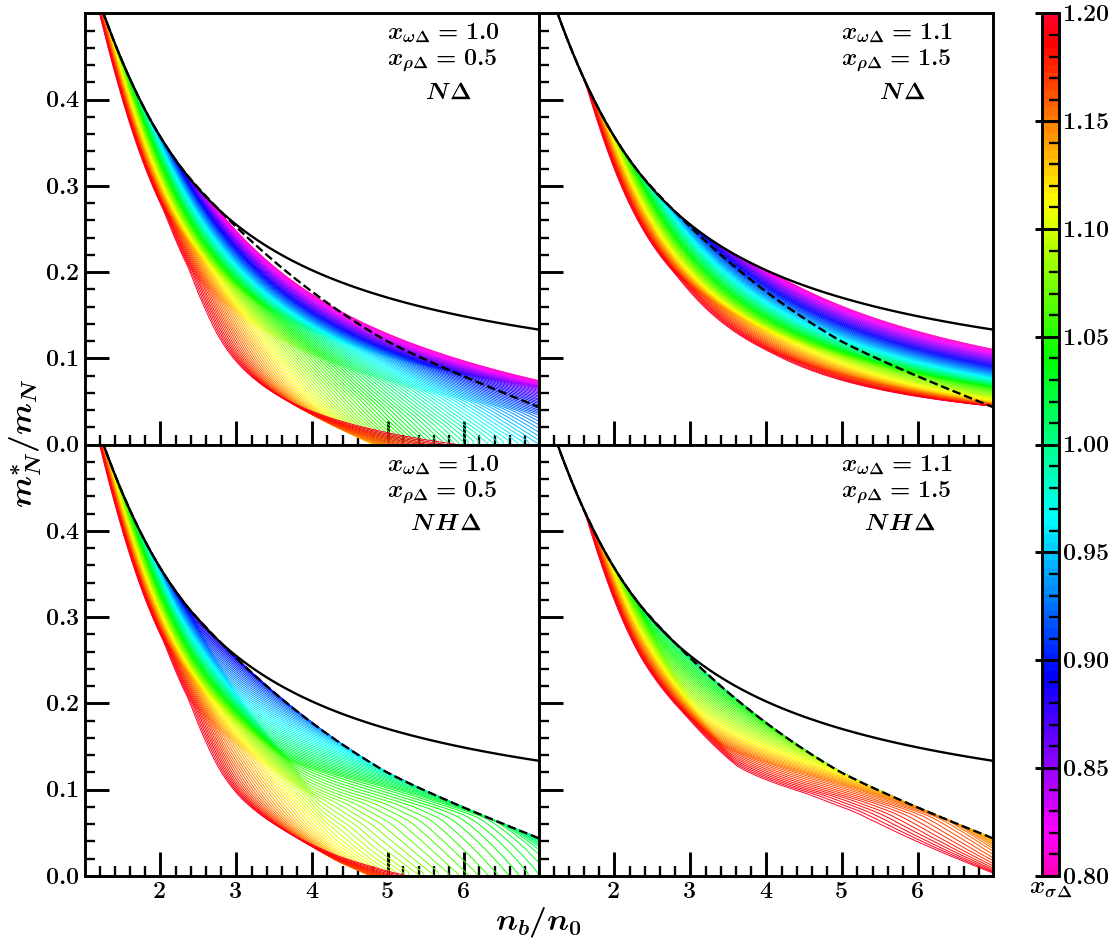
Beyond protons and neutrons, the cores of massive neutron stars may harbour strange baryons (Λ, Σ, Ξ hyperons), delta-baryons (Δ), or even deconfined quark matter. We investigate how these exotic degrees of freedom soften or stiffen the EoS, their role in the "hyperon puzzle," and twin-star signatures from strong first-order phase transitions.
Thermal Evolution & Proto-Neutron Stars
Newly born proto-neutron stars are hot (~50 MeV) and lepton-rich. We study how finite temperature and trapped neutrinos modify the EoS, alter composition, and affect macroscopic structure. Our work also covers neutron star cooling: the Urca processes, modified Urca, pair-breaking-formation, and how they constrain the density-dependence of nuclear symmetry energy and superfluid pairing gaps.
Multi-Messenger Astrophysics
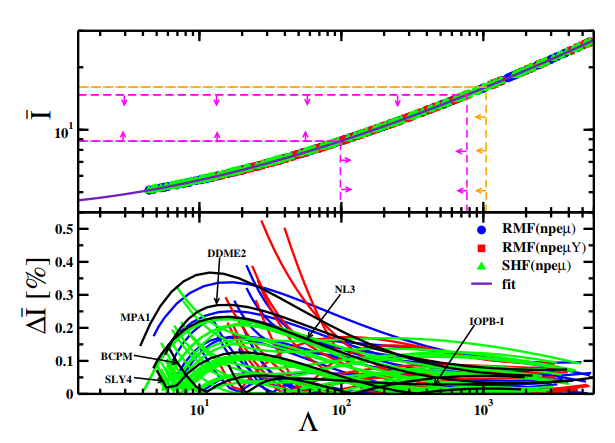
The 2017 neutron star merger GW170817 ushered in the era of multi-messenger nuclear astrophysics. We use simultaneous GW + EM constraints to infer the EoS, tidal deformability, moment of inertia, and nuclear symmetry energy. We also study how future observations with LIGO-India, AstroSat, and SKA can disentangle different EoS models and detect exotic phases of matter.
Codes & tools
TOV Solver & compact-common
General-relativistic TOV integration code for computing mass-radius relations, tidal deformabilities, and moment of inertia for arbitrary EoS tables.
GitHub ↗Oscillation Mode Solver
Radial and non-radial oscillation mode calculation (f-, p-, w-modes) using Cowling approximation and full GR perturbation equations.
GitHub ↗Two-Fluid Dark Matter TOV
Modified TOV solver for dark matter admixed neutron stars. Supports WIMP and fermionic dark matter with varying interaction cross-sections.
GitHub ↗Collaborations
LIGO-India / IUCAA, Pune ↗
Gravitational wave data analysis, parameter estimation, and EoS constraints from binary mergers.
Prof. Sukanta Bose (Scholar) ↗University of Tsukuba, Japan ↗
Nuclear structure and astrophysics (CEFIPRA collaboration). Group of Prof. Takashi Nakatsukasa.
Prof. Nakatsukasa (Tsukuba) ↗IOP Bhubaneswar ↗
Nuclear matter, EoS, and neutron star structure. Groups of Prof. S K Patra and Prof. B K Agrawal (SINP).
Prof. S K Patra ↗ Prof. B K Agrawal (Scholar) ↗INFN Catania, Italy ↗
Neutron star properties with dark matter and exotic EoS. Dr. H C Das.
Dr. H C Das (Scholar) ↗University of Coimbra, Portugal ↗
Nuclear EoS, tidal deformability, and GW170817 constraints. Dr. Tuhin Malik and Prof. Constança Providência.
Dr. Tuhin Malik (Scholar) ↗ Prof. Providência (Scholar) ↗University of Chile & Ohio University ↗
Oscillation modes and dark matter in compact stars. Prof. Grigoris Panotopoulos and Prof. Tianqi Zhao.
Prof. Panotopoulos (Scholar) ↗ Prof. Zhao (Scholar) ↗CITA, University of Toronto ↗
GW170817 universal relations and neutron star parameter inference. Dr. Philippe Landry.
Dr. Philippe Landry (Scholar) ↗RIKEN, Wako, Japan ↗
Nuclear structure and neutron star matter. Dr. Ankit Kumar.
Dr. Ankit Kumar (Scholar) ↗Funding
Our research is supported by the Science and Engineering Research Board (SERB) ↗, Department of Science & Technology, Government of India, and the Department of Atomic Energy – Board of Research in Nuclear Sciences (DAE-BRNS) ↗. International collaboration is supported through CEFIPRA (India–France) ↗.